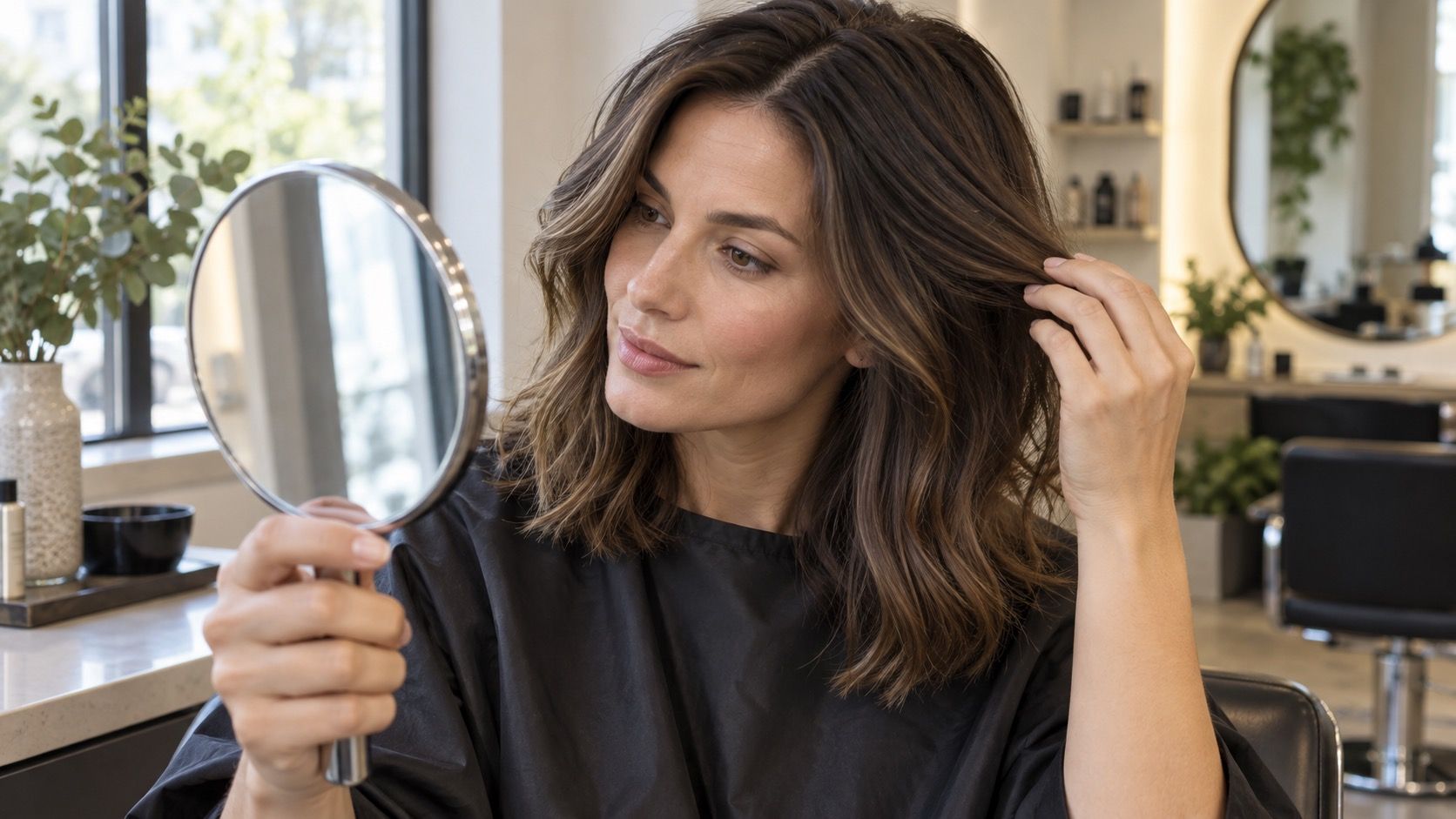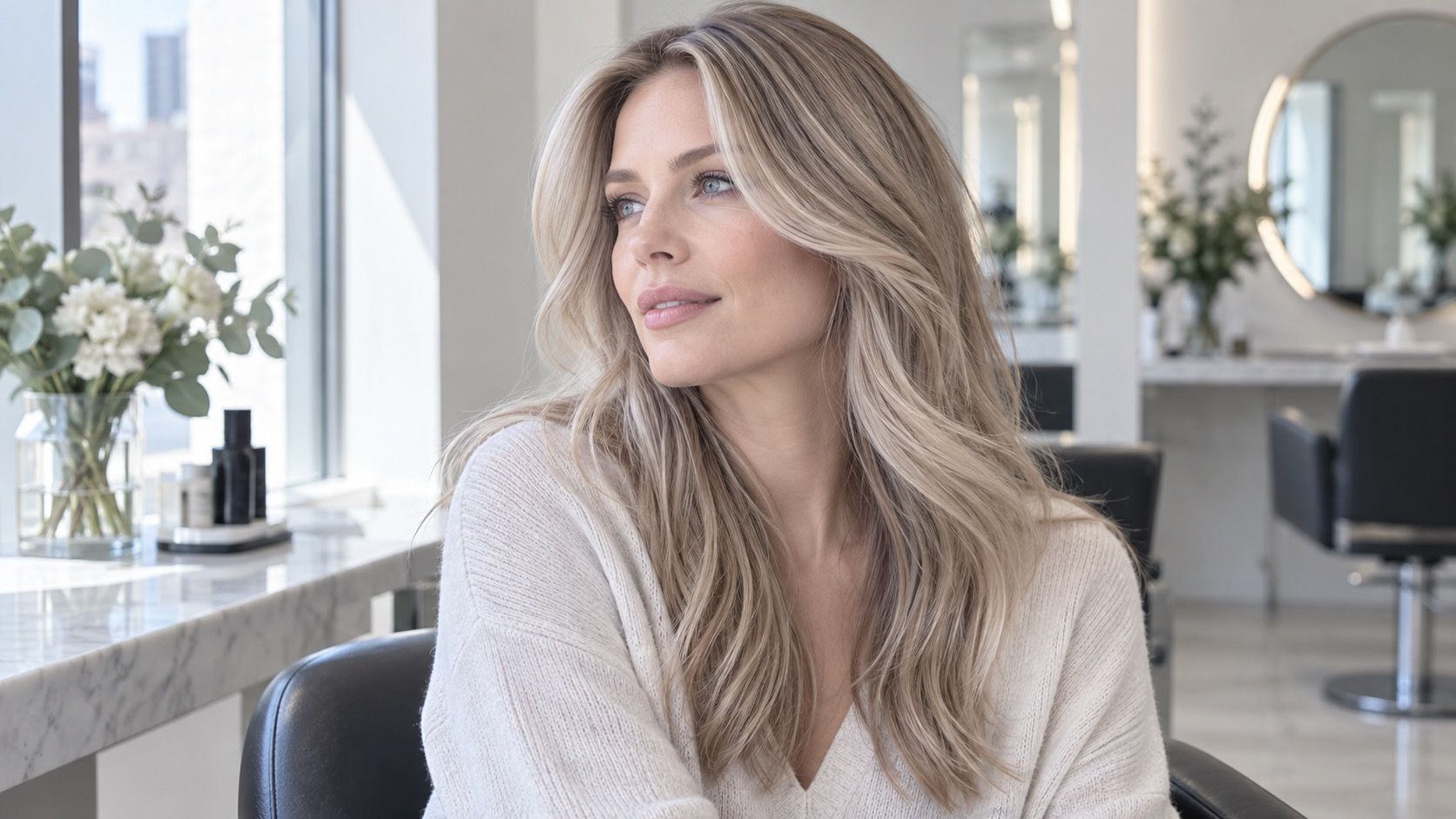
Low-maintenance hair colour should not mean giving up and letting an old salon job fade in whatever direction it chooses. The best version is planned around your natural base, the place your hair grows out most visibly, and the amount of chair time you genuinely want. It looks quietly finished on a rushed Monday, not only in the first ten minutes after a blow-dry.
Define “low maintenance” before choosing a colour family
People use the phrase for several different things. Some mean they do not want a hard line at the roots. Others mean they can only book appointments a few times a year, do not want frequent toner visits, or do not want to fight orange or dullness at home. These are related, but they lead to different choices. A soft-rooted blonde may solve the regrowth problem while still needing tonal care; a close-to-natural brunette may be easy at the roots but feel flat without an occasional gloss.
Start by writing down your non-negotiable. Perhaps you wash every day after training, spend weekends in the sun, cover grey at the temples, or wear a centre part that exposes every millimetre of new growth. Then name the maintenance you do not mind. Many people are happy with a quick gloss and a few face-framing pieces, but unhappy with a full root appointment that arrives just as the calendar gets busy.
A hair color analysis can help here because it separates the colour you admire from the level and contrast that suit your own features. The point is not to be assigned a rigid palette. It is to notice that a deep black, icy blonde or saturated copper has a stronger visual commitment than a neutral medium shade close to your natural root.
Choose a grow-out pattern, not just a before-and-after
The clearest sign of an easy colour is what happens at the parting after several weeks. If your natural base and coloured root are close in depth, new growth reads as soft shadow rather than a stripe. That is why root shadows, melted roots and fine blended highlights are so useful: they deliberately leave some depth near the scalp and make the transition part of the design.
Placement matters as much as tone. A scattered, fine highlight pattern can keep movement through the lengths without creating a bright shelf at the crown. Balayage can be low maintenance when it is painted away from the root and blended through the mid-lengths, but it is not automatically easy. A very light balayage over a dark natural base will still announce its growth, especially under a centre part or when hair is tied up.
Ask the stylist to show where the brightness begins and how the hairline will look as it returns. The tiny pieces at the temples are often the first part you see in the bathroom mirror. If you have grey there, a deliberately softened blend may be more forgiving than trying to cover every strand with one solid shade.
| Colour approach | Why it can grow out softly | Maintenance caveat |
|---|---|---|
| Rooted dimensional blonde | Natural depth stays at the scalp while fine lightness moves through the lengths | Lightened ends and toner can still need care |
| Soft brunette with a gloss | Stays near the natural base and fades without a sharp root line | Shine and richness may need periodic refreshing |
| Grey blending highlights | Breaks up the contrast between grey and pigmented hair | Placement around the hairline needs planning |
| Muted copper or strawberry warmth | Can look natural when close to a warm base | Warm tones may lose brightness faster than neutral browns |
For blonde, make brightness selective
Blonde becomes demanding when every strand near the scalp must stay pale. A more workable alternative is a lived-in blonde: preserve a root close to the natural base, add fine brightness around the face, and let the lightest pieces live through the lengths rather than forming a solid cap. It still feels blonde when the hair moves, but it does not punish you for missing one appointment.
Face-framing highlights make a big visual difference for relatively little surface area. They can brighten the front in daylight and leave enough depth behind them to keep brows and eyes defined. The caution is placement: a dramatic, very pale money piece may grow out more obviously than the rest of the hair. Ask for a softer edge if you like the bright effect but not the maintenance message it sends.
A hair color simulator is useful for comparing a rooted beige blonde with an all-over pale blonde on your own face. Look beyond the first reaction. Does the lighter version make you want to change your brow makeup? Does the rooted version still feel bright in a plain selfie? Those are more useful clues than whether the simulated shade looks fashionable under a filter.
For brunette and red, protect dimension rather than chasing darkness
A low-maintenance brunette is usually not one opaque dark blanket. It has a base close to the natural root and a little variation: quieter lowlights, a warm or neutral glaze, or finer pieces that catch light through the ends. This matters especially on thick or wavy hair, where solid dark colour can swallow texture. On fine hair, a richer close-to-base depth may create the appearance of density, but a touch of movement keeps it from looking like colour alone is doing all the work.
Warm brunettes and soft coppers can be surprisingly easy when the starting point already has gold, auburn or medium brown warmth. The difficult version is the one that fights the natural base: a very cool brown over persistent warmth, or a vivid red expected to stay fiery with no refresh. If you enjoy warmth but worry about it becoming brassy, ask for a tone that can fade gently rather than one that depends on perfect saturation.
Red deserves an honest conversation. A subtle strawberry or cinnamon veil may grow out beautifully; a high-impact copper can fade faster and may need more attention to remain the exact shade you first loved. Neither is better. Choose the red whose faded version you can still picture yourself wearing to work, at the gym and in ordinary daylight.
Use grey blending as a design choice, not a delayed decision
Grey hair changes the definition of easy upkeep because it is often brightest around the temples and parting. Solid coverage can give a uniform result, but the return line may be the most visible part of the whole style. Grey blending works differently: it introduces lighter or cooler pieces so new silver strands have company. The result is less about hiding every grey hair and more about reducing the contrast that makes regrowth shout.
The right route depends on where your grey lives. A few scattered strands through medium brown hair may blend well with delicate highlights. A bright front streak can be incorporated with a face frame or softened by a translucent gloss. Bring a daylight photo of the hairline pulled back; it tells more than a description such as “not much grey,” which often overlooks the very area people see first.
Do not accept grey blending as a vague promise. Ask how it will look when you wear your normal part, whether the front will be brighter than the back, and what the transition will look like at the next appointment. A plan with those answers feels intentional from the beginning.
Build the appointment rhythm around real life
The colour with the lowest theoretical upkeep is not always the best choice. If you enjoy the ritual of a seasonal salon visit, finely blended lightness may fit beautifully. If work, travel or family life makes appointments unpredictable, a close-to-root gloss, gentle dimension and a forgiving grow-out may give more peace of mind. Your ideal interval belongs to your diary, not to a trend description.
At the consultation, ask which part of the result will change first: root, tone, brightness or shine. Then ask for a minimum plan and a nicer-to-have plan. The minimum might be gentle washing and occasional conditioning; the nicer-to-have might include a gloss before a special event. This keeps maintenance from becoming an all-or-nothing routine you abandon after two weeks.
Take a few finished photos outside after the appointment, including your usual part and hair-up style. They become a much better reference than a saved image of someone else. Low-maintenance colour succeeds when it remains recognisably good between appointments: not identical to day one, but still balanced, dimensional and clearly yours.